"Tomorrow Never Knows" closes Revolver, but it was the first song the Beatles recorded for the album. April 1966, EMI Studios Three. Listen to it now and the placement makes sense. The song ends one Beatles era and starts another in the same three minutes.
John Lennon wrote it, pulling lines from Timothy Leary's "The Psychedelic Experience." He wanted a mantra, not a song. All four Beatles contributed tape loops to the recording, but the loops were Paul McCartney's idea. He had been making them at home, splicing fragments of guitar feedback, sitar, orchestral chords, and laughter into rotating spools. He brought the technique into Studio Three and George Martin, Geoff Emerick, and Ken Townsend figured out how to actually record it.
What was already happening in studios in 1966
People had done strange things in studios before "Tomorrow Never Knows." Phil Spector had stacked instruments into a wall of sound. Joe Meek had made pop records that sounded like science fiction. The musique concrète composers had been cutting tape since the 1940s. None of that is new.
What was new was that all of this strangeness was now happening on a Beatles single. The biggest pop band in the world had decided that the recording studio was not the place where a song got captured. It was the place where a song got built.
That distinction matters. Most pop records of 1966 still pointed back to a band that could be imagined in a room. "Tomorrow Never Knows" did not.
How the song was actually made
The drone behind it was George Harrison's tambura, removing any sense of chord progression. Ringo Starr's drums did not keep time the way pop drumming had been keeping time. They circled, pounded, and returned. The pattern was less like a backbeat and more like an early breakbeat.
Lennon told George Martin he wanted his voice to sound like thousands of Tibetan monks chanting on a hilltop. Martin and Geoff Emerick could not literally produce that. So Emerick ran Lennon's vocal through a Leslie speaker, which was normally used to give a Hammond organ its rotating sound. The result was a voice that hovered, smeared, and felt detached from a body.
Ken Townsend's invention helped too. ADT, automatic double tracking, let Lennon's vocal be doubled without re-recording it. On any other song this would be a convenience. On this one it became part of the texture. The voice sounded unsteady, almost as if it had drifted away from the singer.
Why the loops are the real revolution
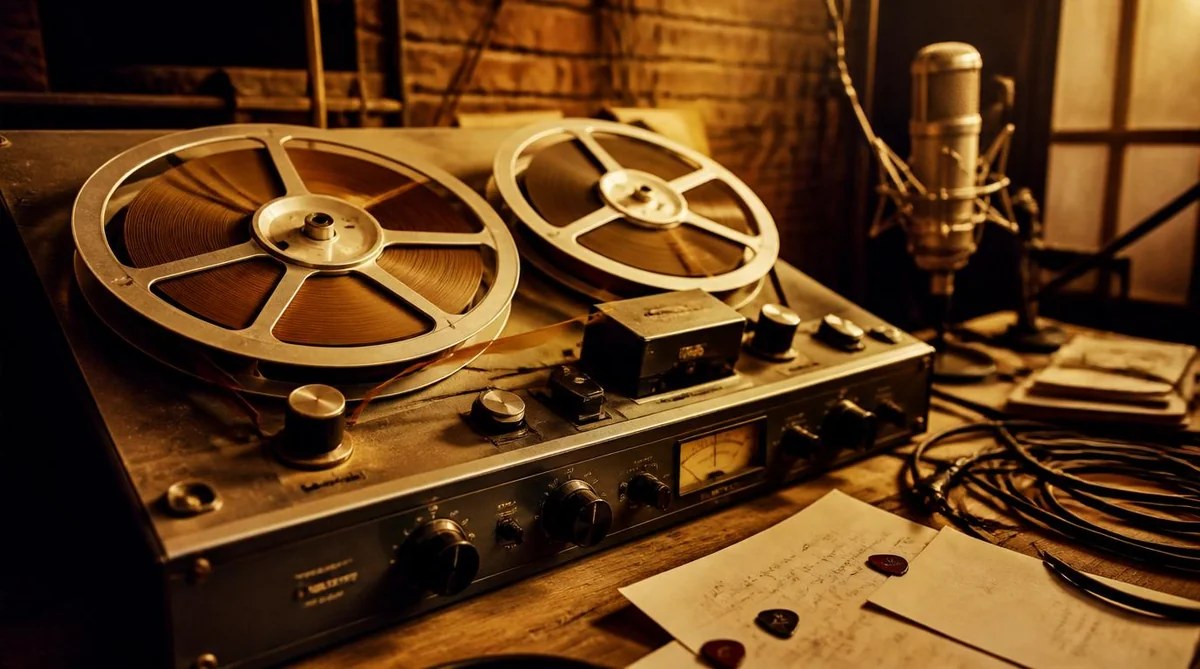
McCartney had been carrying tape loops around in a paper bag, evangelizing them to anyone who would listen. The Beatles recorded their own loops at home and brought them in. Each Beatle made his own. To play them back, the studio rigged up multiple tape decks in different rooms, with engineers and assistants holding pencils through the spools so the loops would stay in motion.
Then the magic move. Each loop was fed into the mixing console. George Martin rode the faders. He brought loops in, faded them out, layered them in real time. The loops were not background. They became musical events that arrived, collided, vanished, returned. The mixing board itself became the instrument.
McCartney did not do this alone. Lennon wrote the words. Martin produced. Emerick engineered. Townsend invented ADT. Harrison and Starr held the floor. But the loop experimentation, the wedge that turned the recording studio into a compositional space, came in with McCartney.
What came after
After "Tomorrow Never Knows," the studio was a different place.
In 1967, the Beatles built "Being for the Benefit of Mr. Kite!" out of cut-up calliope tape. Pink Floyd's "Piper at the Gates of Dawn" arrived later that year, drenched in studio-built unreality. By the mid-1970s, Brian Eno had built "Another Green World" by treating the studio process itself as the composition, not the documentation of one. In 1981, David Byrne and Eno made "My Life in the Bush of Ghosts" almost entirely from found voices and sampled speech. The Chemical Brothers' "Setting Sun" in 1996 ran Noel Gallagher's vocal through electronics and repetition until it sounded like Beatles psychedelia at 130 BPM.
These records did not copy the sound of "Tomorrow Never Knows." They borrowed the philosophy. The recording is the song. The studio is the band.
That idea is now invisible. Modern pop assumes it. Hip-hop assumes it. Electronic music assumes it. The voice gets chopped into a hook. The drums get manipulated until they no longer sound like drums. A sample carries the emotion of a whole track. Listeners do not even register these as choices anymore.
That is why "Tomorrow Never Knows" sounds less shocking than it did in 1966. Its most radical idea got absorbed. Using the recording studio as an instrument is not a fringe move anymore. It is just how records get made.
The Beatles got there first. With McCartney's paper bag of tape loops.
---
Sources:
- The Beatles official song page. Tomorrow Never Knows. https://www.thebeatles.com/tomorrow-never-knows
- The Paul McCartney Project. Tomorrow Never Knows. https://www.the-paulmccartney-project.com/song/tomorrow-never-knows/
- Wired. Paul McCartney Brings Tomorrow Never Knows Back to the Future. https://www.wired.com/2011/06/mccartney-tomorrow-never-knows/
- The Beatles Bible. Tomorrow Never Knows. https://www.beatlesbible.com/participant/tomorrow-never-knows/
- The Beatles Bible. 6 April 1966: Recording, Tomorrow Never Knows. https://www.beatlesbible.com/1966/04/06/recording-tomorrow-never-knows/
- Pitchfork. The 5 Techniques That Made George Martin the OG Super Producer. https://pitchfork.com/thepitch/1051-the-5-techniques-that-made-george-martin-the-og-super-producer/
- David Byrne official site. My Life in the Bush of Ghosts. https://www.davidbyrne.com/explore/my-life-in-the-bush-of-ghosts/explore
- The Guardian. The best No 1 records: The Chemical Brothers feat Noel Gallagher, Setting Sun. https://www.theguardian.com/music/2012/may/31/chemical-brothers-noel-gallagher-setting-sun