The cover of Press to Play shows Paul and Linda McCartney in sepia close-up, photographed by George Hurrell, the same Hollywood portraitist who shot Bogart and Garbo in the 1930s, using the same camera he'd used forty years earlier. It's an intimate, deliberately old-fashioned image. It is also one of the most misleading covers in the McCartney catalog. The album inside sounds nothing like that photograph.
Released August 25, 1986, Press to Play came out at a complicated moment. McCartney was thirteen years past Wings, two years past the box-office disaster of Give My Regards to Broad Street, and three years past his last all-new studio album, Pipes of Peace. The reputation that followed Press to Play was set quickly: dated production, uneven songwriting, an artist chasing trends he didn't need to chase. It charted at #8 in the UK but never cracked the US Top 20, and it remains one of the lowest-selling studio records of McCartney's solo career.
That reputation isn't wrong. But it isn't the whole story either. Press to Play is not a hidden masterpiece. It is also not the empty misfire its reputation suggests. It is the most revealing transition record McCartney made in the 1980s, flawed, overproduced, occasionally beautiful, and far more interesting than its sales figures would lead you to believe.
Why the album sounded the way it did
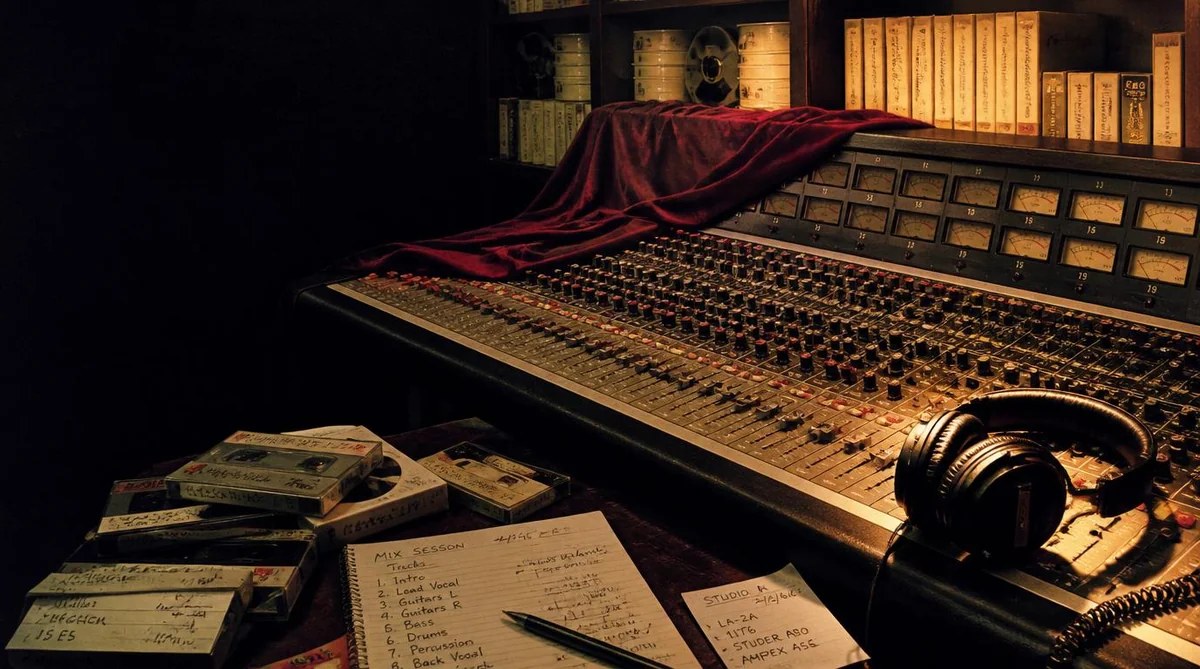
McCartney co-produced Press to Play with Hugh Padgham, who at that moment was one of the most in-demand producers in the world. Padgham had recorded Peter Gabriel, Genesis, Phil Collins, The Human League, The Police, and XTC. He was associated with a specific sound, the gated reverb of "In the Air Tonight," the cavernous drums of No Jacket Required, and McCartney hired him to bring that sound to a McCartney record. That was the point. It wasn't an accident.
The guest list amplified the effect. Eric Stewart, formerly of 10cc, co-wrote six of the album's ten songs and played guitar throughout. Phil Collins appeared on a track. Pete Townshend played on another. Jerry Marotta, who'd recently drummed for Peter Gabriel, played drums on most of the record. Linda McCartney provided background vocals, the last remaining link to Wings.
McCartney knew, even at the time, how it would be received. In a 1986 Parlophone promotional interview reproduced on The Paul McCartney Project, he explained why he limited Phil Collins to a single track: "I didn't want to get Phil too heavily involved because of the risk of people saying 'Oh you're just going for flavour of the month.'" He was aware of the trap. He went into it with his eyes open.
The production is exactly what you'd expect from Padgham in 1986. Drum machines drive several tracks, including the title song, whose bass line, McCartney admitted, is "a machine playing it." Synths sit close to the front of the mix. The drums are huge. The reverbs are long. Nothing about the sonic palette is subtle.
The songs are stronger than the reputation suggests
The easy criticism of Press to Play is that the songwriting is weak. The closer reading is that the songwriting is uneven, but the strong material is genuinely strong, and the album never gives it the frame it deserves.
"Stranglehold" opens the record with what the Rolling Stone review at the time called a "snare-slamming rocker". Peppy horns, a tight chorus, and a sense of muscle McCartney rarely brought to his solo work in this era. "Good Times Coming / Feel the Sun" is the closer to classic McCartney on the record. a two-part suite of the kind he'd been writing since Abbey Road, with reggae touches in the first part and an unironic optimism in the second. The structure is pure McCartney even when the production isn't.
"Pretty Little Head," co-written with Eric Stewart, is the most experimental thing on the record and the one that most rewards repeat listening. It's dreamy, abstract, built on a hypnotic bassline and layered backing vocals, and it sounds like nothing else in the McCartney catalog before or since. "Footprints" is a quiet acoustic ballad that survives the production almost entirely. "However Absurd," the closer, is the most overtly Beatlesque thing on the album, stream-of-consciousness lyrics drawing from W. H. Auden, a grand orchestral arrangement, and a melody that wouldn't have been out of place on Sgt. Pepper.
The album also has its failures. "Talk More Talk" is an interesting idea, spoken-word fragments over a polished groove, that doesn't quite cohere into a song. "Angry" is energetic but undercooked. And there are stretches where the production simply outweighs the material, where you can hear McCartney's instincts straining against the eighties drum sound.
Where it sits in the catalog
Press to Play was McCartney's first album of new songs since Pipes of Peace in 1983, and his first since the commercial and critical failure of Give My Regards to Broad Street. He needed to do something. The Padgham collaboration was that something, a deliberate, considered move away from the McCartney house style toward the mainstream pop production of the moment.
Padgham himself has been blunt about the album in the years since. McCartney has largely disowned it. But there is a strong case that Press to Play is the most honest snapshot we have of a great artist trying to figure out where he fits in a decade he didn't entirely belong to. Tug of War and Pipes of Peace leaned on George Martin and Beatle-era touchstones. Flowers in the Dirt (1989) would be a return to form, with Elvis Costello as co-writer. Press to Play sits between those two impulses, neither looking backward nor finding a future. That's exactly what makes it a transition record. It's the sound of a working musician trying things, even when the things don't all work.
The honest verdict
Press to Play isn't a great McCartney album. It probably isn't even a good one, depending on what you weigh. The production has aged poorly. Several tracks are forgettable. The commercial failure was real and was deserved by the metrics of the time.
But the case for revisiting it is also real. It contains "Stranglehold," "Pretty Little Head," "Footprints," and "However Absurd", four songs that more than justify the price of admission. It captures a great artist trying to do something genuinely new at a moment when he could have coasted. And it tells you more about McCartney's relationship to the eighties than the more polished, more successful records that came before and after it.
It is, in the most specific sense, an interesting record. That doesn't sound like high praise. For an album that has spent forty years being written off, it's higher praise than it usually gets.
---
Press to Play is available on Apple Music and Spotify. The expanded 1993 CD reissue and the 2017 Press to Play deluxe set include additional B-sides, remixes, and the original "Spies Like Us", worth seeking out for completists.